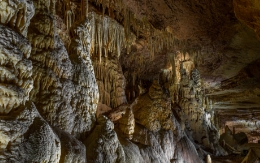
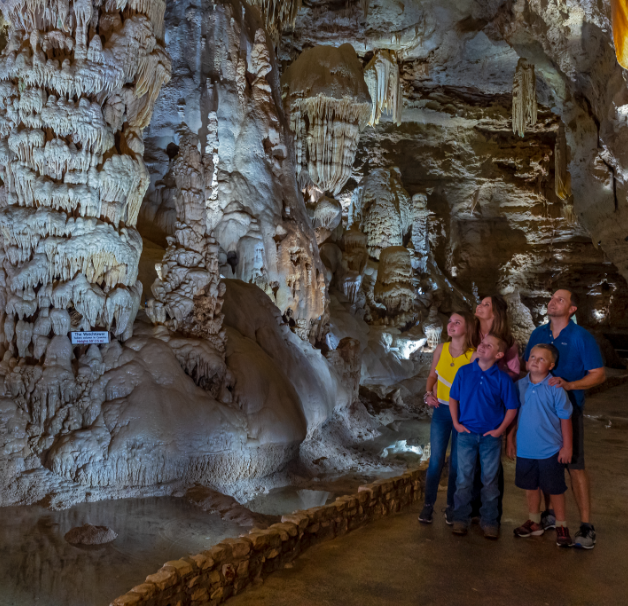
Visitors to the caverns walk through different layers of limestone, a sedimentary rock. Geologists theorize that during the Cretaceous period, a warm, shallow sea covered much of Texas. Sediments and dead marine organisms collected on the ocean floor, compacted and formed the different limestone layers. Geologists give different names to the various layers, and visitors to Natural Bridge Caverns will find the Glen Rose and the Kainer (Edwards) layers. The Glen Rose, as the oldest rock layer, contains the lowermost chambers, while the Kainer forms the Natural Bridge.

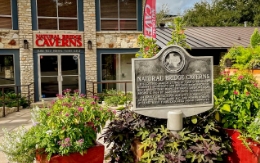
Natural Bridge Caverns, while already on the list of fun things to do in San Antonio, has now been listed in the National Register of Historical Places (NRHP), a designation given by the U.S. Department of Interior for sites that have an important role in preserving cultural history. In 1963, development-related excavations took place at Natural Bridge Caverns to enlarge the entrance, provide a walkway, and develop a trail system inside the cavern. During the original trenching of the entrance, several diagnostic projectile points dating back approximately 10,000 years were salvaged. Additionally, several other stone tools were recovered during this phase of development, including hide scrapers, gouges, knives, and drill fragments.
Staff from the Texas Memorial Museum and the Vertebrate Paleontology Laboratory of the University of Texas visited the site and surface collected a sample of faunal remains uncovered by the construction. Some specimens belonged to species that became extinct about 12,000 years ago.
National Register of Historic Places Plaque In June of 2003, the staff from the Center of Archaeological Research (CAR) from the University of Texas at San Antonio conducted a dig at the entrance of the caverns. Artifacts uncovered include a prehistoric cooking hearth, stone tools, projectile points, and charred plant remains. People from long ago used these artifacts to hunt, cook, and make tools. They help us learn about what life was like for early inhabitants of the Texas Hill Country.