












The Back Story of Discovery of Wildcats in Natural Bridge Caverns
Overview
The University of Texas Jackson School of Geosciences and Natural Bridge Caverns and are launching a joint expedition in January to solve an ancient mystery: what kind wild cats left tracks/paw prints one mile from the entrance inside Natural Bridge Caverns – and are they the same wild cats whose bones lie at the base of a sheer drop in the cave?
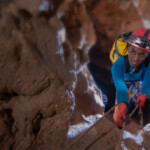
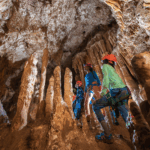
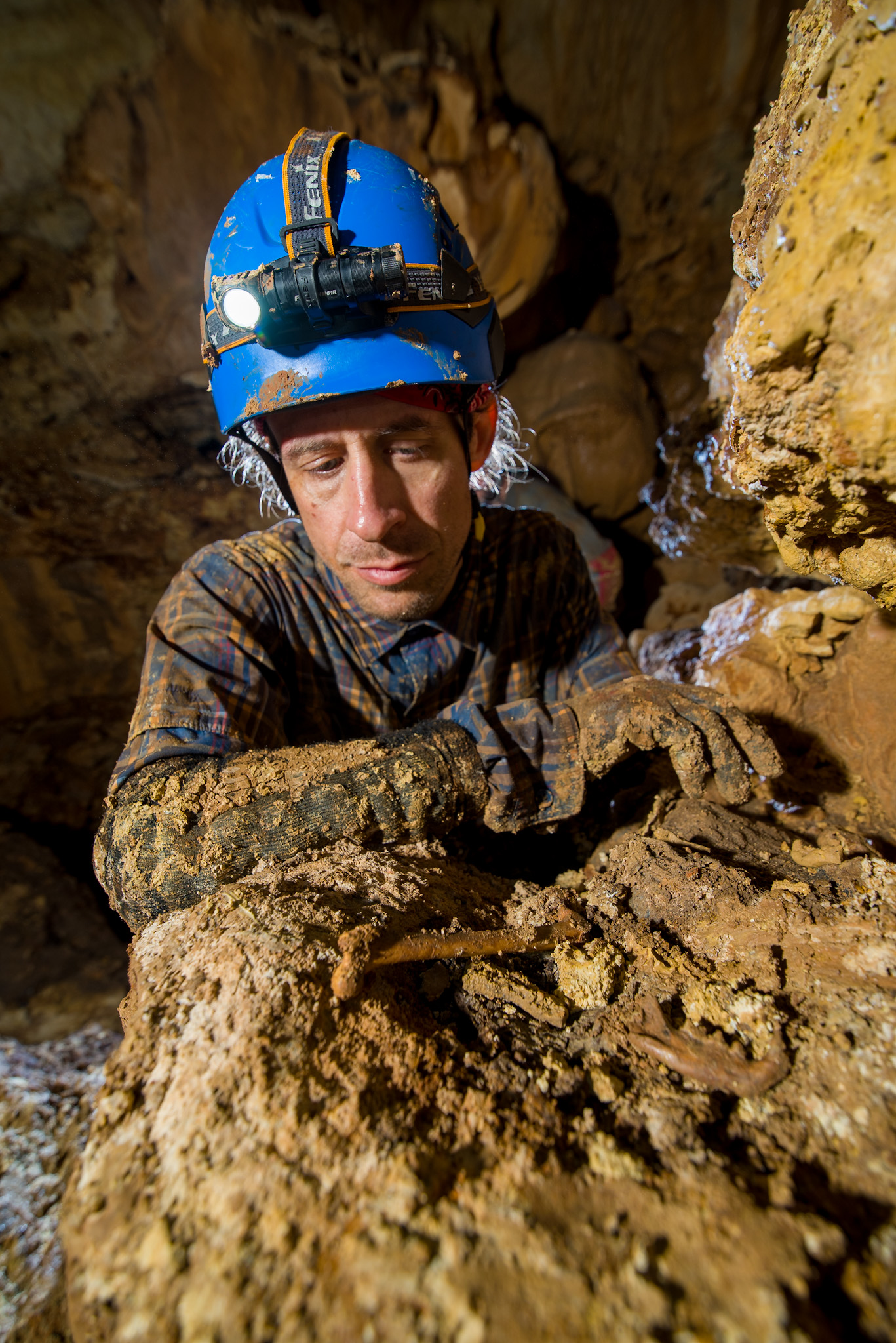
The expedition to recover the bones, examine the trackways, and begin the process of study will be led by John A. Moretti from the Jackson School and Brad Wuest, president of Natural Bridge Caverns. It will involve complex ascending and descending rope work and crawling through tight muddy passages to get to the three sites where the bones have been undisturbed. The team will then carefully extract the bones and encase them to ensure they survive the trip back through the Cavern.
New Wild Cats Found
In June of 2021, Wuest led an expedition to rig access pits and re-survey a large chamber and passage complex called the “Dungeon”. On that expedition the team found fossilized bones embedded in calcite formation. The team knew a wild cat skeleton had been discovered in the past on the Dungeon floor eighty feet below a series of pits however, the newly found bones were in a different location at the top of a slope of rubble and flowstone. Wuest contacted paleontologists with the Jackson School to learn more about the bones previously collected in Natural Bridge Caverns during the early 1960’s, to see if photos of the newly found bones could be identified and coordinate plans for their retrieval.
Finding Tracks
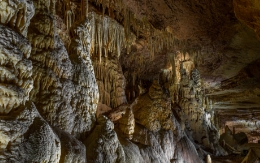
Following that outreach to the Jackson School, a highly unusual set of cat tracks were discovered in March of 2022 during a biological survey of the cavern, some tracks only ten feet from the mouth of the pit about eighty feet above the wild cat bones originally found on the Dungeon floor. The tracks are a full mile from the only known natural entrance into the cavern through completely dark and muddy passage, giant chambers, and many potential pitfalls and ½ mile from the closest commercial trail in Discovery Cavern. Within one week of discovering the cat tracks even more wild cat bones were discovered at the bottom of a sixty-foot-deep pit in a huge chamber called the Inferno Room. Tracks were also found not far from the top of this pit. Later yet, a third wild cat partial skeleton was found in a completely different area of the cave, closer to the entrance. The partial skeleton is nearly complete, a rare occurrence in specimens of small cats in the fossil record, and includes a partial skull, upper dentition, left and right dentaries, and all major limb elements.
History: Bones from 1960s
These are not the first set of wild cat bones discovered at Natural Bridge Caverns. The first were extracted in 1963 by early cave explorers, and initially identified by the University at Texas as a bob cat. However further research on wild cats has indicated that it’s possible that the bones are likely to be from an extinct form of a river cat, or potentially, a jaguarundi (which is now considered extinct in Texas). The 1963 recovered bones are part of the Jackson School’s collection; these new bones will be as well.
Additional photos and video available here.